
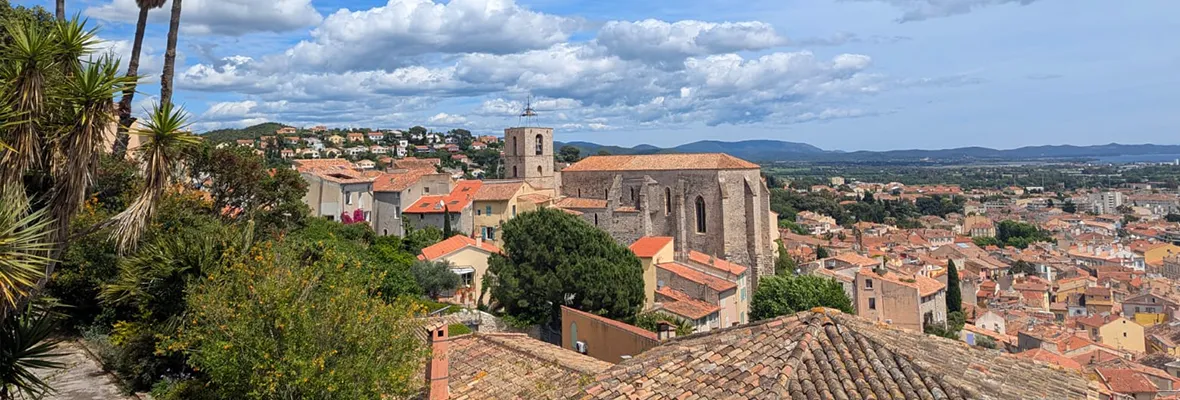
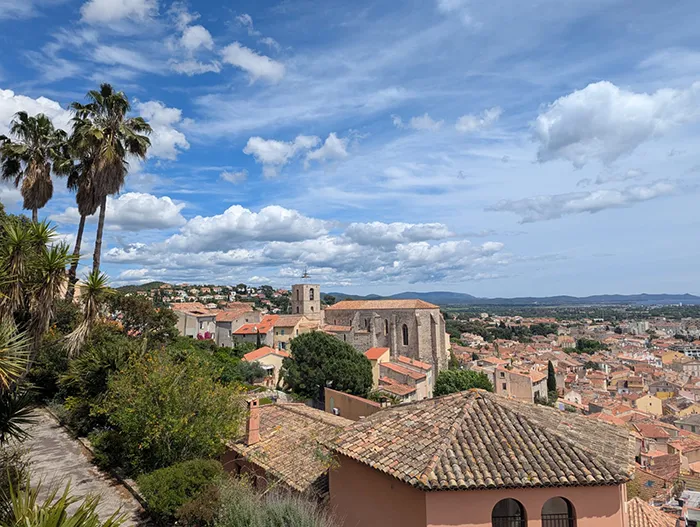
Everyone knows Saint-Tropez. Almost no one stops long enough in Hyères — and that is exactly why we love sending people there. Long before the Côte d'Azur became an international destination, wealthy European visitors were already coming here for the winter, and the town has quietly kept its secrets ever since: a medieval hilltop, a cubist villa hiding above the rooftops, a lagoon full of kitesurfers, and three islands most visitors never make it out to.
What follows is not a checklist. It is the Hyères we actually take our own guests to — the café we return to, the window table we book, the boutique we pop into on the way down from the château. And there is plenty more we haven't put on paper; ask our team when you're planning your trip.
Jump to: A promontory worth fighting for • The English winter colony • The old town & Café Vola • Villa Noailles • La Banque museum • Beaches, windsurf & kitesurf • Good addresses • The islands • Getting there, when to go & where to stay • Visiting with Beaurouge • FAQ
A promontory worth fighting for
Long before Hyères was a town, it was a position — a hill overlooking a lagoon and a sheltered stretch of coast, and everyone who passed through the western Mediterranean wanted it. Celto-Ligurian communities were established here first, with a fortified settlement on the hill of Costebelle from the late 6th century BC. Then, in the 4th century BC, Greek settlers from Massalia — modern-day Marseille — founded Olbia on the coast nearby, a fortified colony built in part to protect their maritime trade routes. The Romans, drawn by the same defensible terrain, left their own layer beneath what came later.
The town as it stands today only really takes shape in the Middle Ages, climbing the hill around its château. Military-religious orders, the Knights Templar among them, leave a lasting mark on the region — commanderies, pilgrim routes, fortifications. Hyères is built, at this stage, as a place to defend as much as a place to live, long before anyone thought of it as a resort.

The English winter colony
Long before the Côte d'Azur became synonymous with Cannes and Saint-Tropez, Hyères was already welcoming wealthy northern Europeans in search of winter sun. From the 1830s onward, the British aristocracy, and eventually Queen Victoria herself, chose Hyères for the winter, drawn by its mild climate and its gardens. Robert Louis Stevenson lived here from February 1883 to June 1884, and later wrote to his friend Sidney Colvin that he had "only been happy once: that was at Hyeres." Grand hotels, winter gardens and Anglo-Norman villas rise across the hillsides through this period, decades before fashion shifts east, toward the summer light we now associate with the French Riviera.
Walk the residential streets from this period today and you still stumble on these forgotten villas, shutters closed, telling the story of a Côte d'Azur that predates the postcards.
The old town, and the café that watches over it
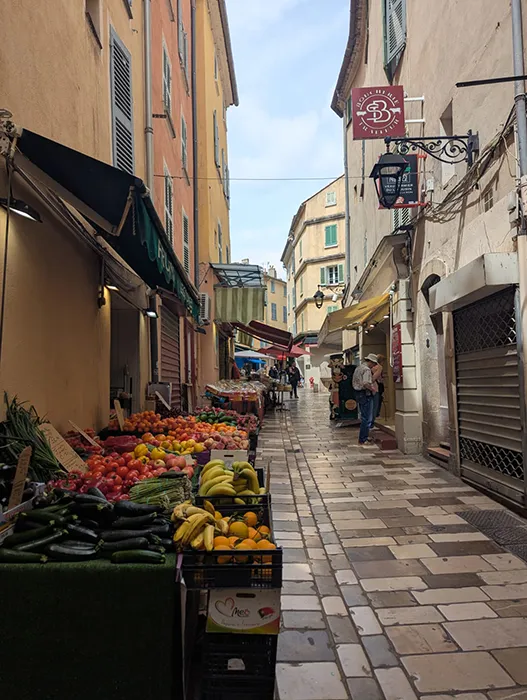
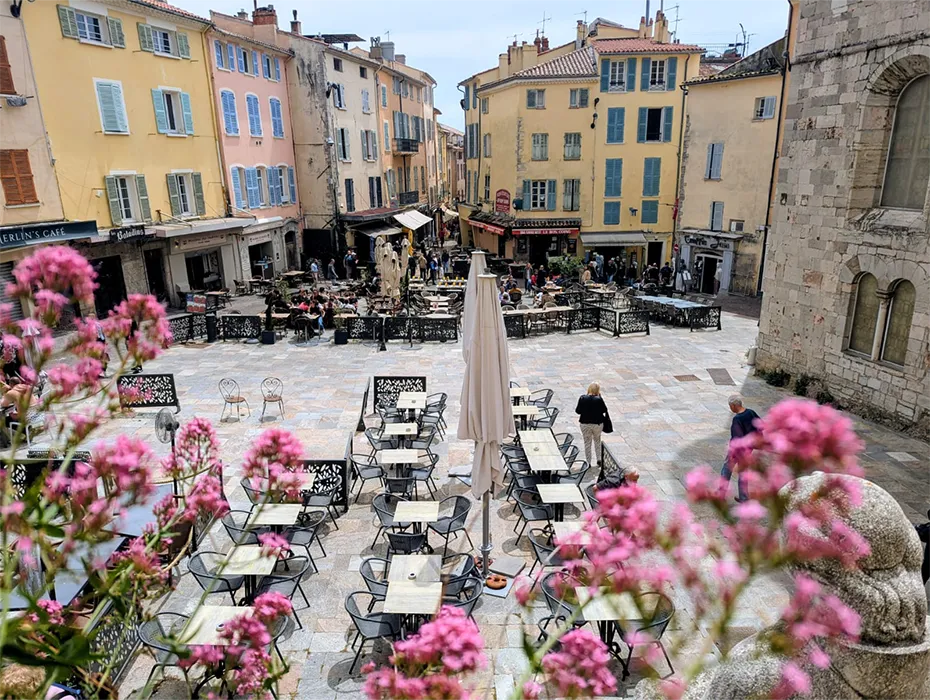
Past the ramparts, the streets narrow, climb, double back on themselves. You lose your bearings on purpose here — that is the whole point. Stone stairways, vaulted doorways, laundry strung window to window: the old town of Hyères has kept a genuinely medieval street plan, intact rather than reconstructed for effect. People still live here, still shop at the market, still close their shutters for the afternoon. Don't try to park inside the old town itself — leave the car in one of the car parks below and walk up; the streets weren't built for anything wider than a handcart, and most aren't built for cars at all.
Vola
Right at the top of that maze, near the summit of the hill, sits Vola. Its terrace looks out over the entire bay of Hyères and the Giens peninsula — one of the most complete viewpoints in town, and still a local secret. Run by Laurence and Nicolas, it is equal parts wine bar, small concert hall and exhibition space: they programme live music and performances through the year, and the kitchen keeps things light — sharing boards, natural wines, produce from the surrounding countryside — for an evening that drifts easily from sunset into music. We usually climb up around 6pm, just as the light over the bay starts to turn.
Villa Noailles, a modernist manifesto
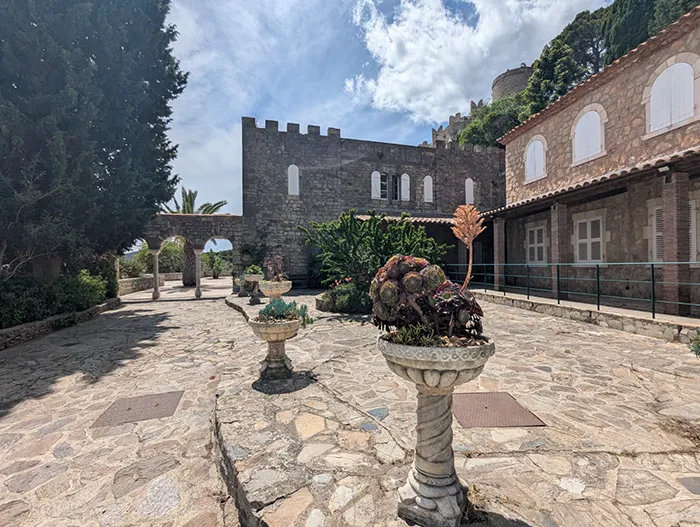
Come back down the other side of the château hill and the architecture changes completely: the Villa Noailles, commissioned in 1923 from architect Robert Mallet-Stevens by the patron couple Charles and Marie-Laure de Noailles. Cubist, unapologetically experimental, conceived as a machine for living decades ahead of its time, it drew in the artistic circle around the Noailles couple — Man Ray, Giacometti and Jean Cocteau among them, Cocteau filming scenes of The Blood of a Poet within its walls.
Restored and reopened to the public, the villa is now a living art centre devoted to design, fashion, photography and architecture: exhibitions rotate through its rooms all year, in spaces that stay in constant conversation with the Mediterranean light — arguably one of the finest examples of modernist architecture open to the public anywhere in the south of France.

La Banque, inside the old Banque de France
Housed in the former Banque de France building, dating from 1925 and standing right in the historic centre, La Banque — Musée des Cultures et du Paysage runs a permanent collection of nearly 200 works tracing the evolution of the Hyères landscape, alongside a temporary exhibition programme worth setting aside an hour for. The early-20th-century banking architecture sits in nice contrast with the collections it now holds.
Beaches, windsurf & kitesurf: the Almanarre and la Capte
Back down at the water, Hyères shows two different faces. To the west, the long, wide beach of l'Almanarre runs for kilometres facing the thermal winds that funnel between the mainland and the Giens peninsula — one of the most consistent windsurf and kitesurf spots on the whole French coast, with the salt lagoons and the silhouette of the presqu'île de Giens as a backdrop. On a good afternoon the water is genuinely full of sails: this is a spot serious riders travel for, not a beginner curiosity, and several schools along the Almanarre teach both windsurfing and kitesurfing at every level, from a first lesson to launching on your own gear. A little further south, la Capte offers calmer, more family-friendly water, lined with colourful beach cabins.
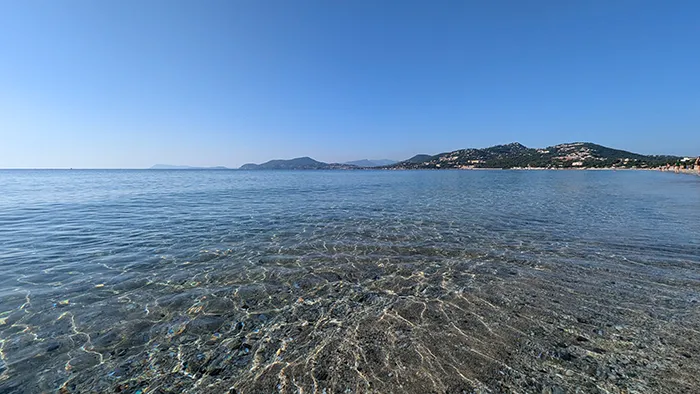
On a windy afternoon, the Almanarre becomes a spectacle in its own right, with windsurfers and kitesurfers filling the bay. Conditions vary with the wind direction, and experienced riders often move from one side of the Giens peninsula to the other accordingly. If you'd rather watch than ride, the beach road makes for one of the best free spectacles on this coast — bring a coffee and stay for sunset over the lagoon.
Good addresses
A few places we keep coming back to — and, as always, plenty more our team can point you to once we know what you're after.
Vola Café
Right at the top of the old town, run by Laurence and Nicolas, with the best view in Hyères and a soundtrack — live music, performances — to match. Natural wines and light plates, best enjoyed slowly as the light turns over the bay.
Luma
An Italian table tucked into the old town, gourmet pizzas and generous plates in a warm, unpretentious room. A reliable choice for a relaxed dinner after a day spent climbing the château's streets.
Le Bar du Soleil à Giens
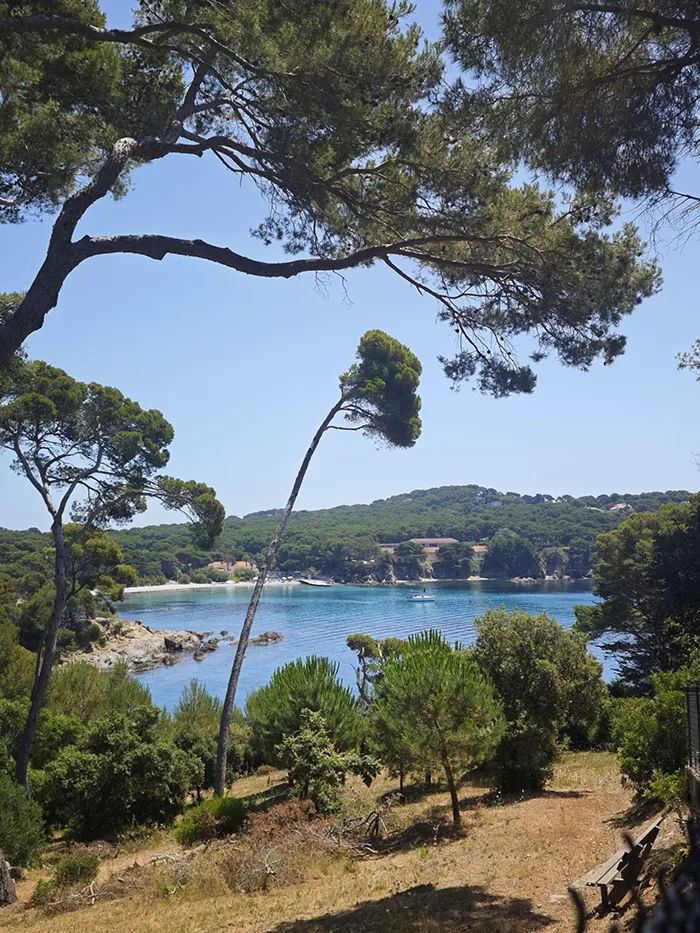
Down on the Giens peninsula, with the kind of unhurried, sun-drenched terrace that makes a long lunch feel entirely justified. A natural stop on the way to or from the Almanarre.
Hôtel Lido Beach
Right on the sand at the Almanarre, with a front-row seat to the windsurfers and kitesurfers offshore. Good for lunch between two sessions on the water, or simply to watch the show with your feet in the sand.
Stella_V Studio
A small fashion boutique in the old town, run by Stella, with a carefully edited selection you won't find in the bigger coastal towns. Exactly the kind of find that rewards wandering the old town without a fixed plan.
These are only a starting point — Hyères has plenty of other addresses worth knowing, from small producers to quieter tables, that we're glad to share once we understand the shape of your trip. Ask our team.
The islands: where the real secret lives
The true secret of Hyères, though, lies offshore. The Îles d'Hyères form a protected archipelago just a short crossing away.
On Porquerolles, the Fondation Carmignac has installed its contemporary art collection across 15 hectares of a working agricultural estate at the heart of the island, with around 2,000 m² of exhibition space and a sculpture garden set among the vines (open seasonally — from late April to early November in 2026). Ferries run from La Tour Fondue, at the tip of the Giens peninsula, in about 15–20 minutes. Port-Cros, created in 1963 and presented as Europe's first marine national park, offers marked underwater trails and a remarkably well-preserved Mediterranean forest. The Île du Levant has held onto a century-old naturist tradition, in a landscape that has stayed deliberately wild.

Getting there, when to go & where to stay
Getting there
Hyères has its own small airport (Toulon-Hyères, TLN), a handful of minutes from the old town and useful for regional and seasonal flights. It's also served by rail: direct TGV INOUI services link Paris to Hyères on selected schedules in around 4½ hours, while regional trains connect the town with Toulon and Marseille. By road, Hyères sits a straightforward 30-minute drive from Toulon — our own base, and if you want the fuller picture of why it deserves a stop of its own rather than just a drive-through, our honest take on Toulon covers the market, Mont Faron and the coves of Cap Brun. Marseille Provence and Nice airports are both under two hours by car, making Hyères an easy add-on to a longer Provence or French Riviera itinerary.
Best time to visit
Late May through June is our favourite window: the gardens and the Villa Noailles are at their best, the water is warm enough to swim, and the Almanarre's thermal winds are already reliable without the peak-August crowds on the sand. July and August bring the strongest, most consistent wind for windsurfing and kitesurfing, but also the fullest beaches and ferries to the islands — book crossings to Porquerolles ahead in summer. Early autumn is a quieter alternative, with the sea still warm and the old town noticeably calmer.
Where to stay
Hyères works well either as a base of its own or as a day trip from Toulon. Travelers who want to be near the wind head for the Almanarre and Giens peninsula, close to Hôtel Lido Beach and the kitesurf schools; those who prefer to walk out onto the château hill in the evening base themselves in or just below the old town, near Villa Noailles and Vola Café. We match each guest to the right style and location — much as we do across the French Riviera — so let us know your priorities (a wind spot at the door, a walkable old town, a quiet garden hotel) and we'll shortlist accordingly.
Villages worth the detour
Hyères also makes an excellent base for exploring the villages strung along this stretch of coast, most of them a short drive east along the Corniche des Maures. Bormes-les-Mimosas, its stone lanes tumbling downhill under bougainvillea and, in late winter, the mimosa that gives it its name, is one of the prettiest villages in the Var. Le Lavandou, just below it, keeps a genuine fishing-port feel alongside a string of well-regarded beaches. Further along, Collobrières in the Maures forest is the place for chestnut markets and a slower pace, while Cogolin and Gassin round out a coastline that rewards travelers willing to go beyond Hyères itself. Ask our team and we'll build a day — or several — around whichever of these fits your trip.
Visiting Hyères with Beaurouge
Hyères rewards travelers who have someone to open the right doors — a morning in the old town with a local guide, lunch on the water at the Almanarre, a private crossing to Porquerolles timed to avoid the crowds. That is exactly what we build, on a bespoke basis, for every traveler who comes to us. It pairs naturally with time in Provence or along the rest of the French Riviera — ask us to weave it into a longer itinerary.
Hyères — FAQ
It's worth a full day on its own. The old town, Villa Noailles, and the Almanarre are each destinations in their own right — most visitors who treat Hyères as a ferry terminal miss all three.
L'Almanarre, on the western side of the Giens peninsula, is one of the most consistent thermal wind spots on the French Mediterranean coast, with several schools teaching windsurfing and kitesurfing at every level.
Regular ferries run from the port of La Tour Fondue, at the tip of the Giens peninsula, with a crossing time of about 15–20 minutes. Private crossings can be arranged to avoid the summer queues.
Yes — the villa is restored and open, with a year-round programme of design, photography and fashion exhibitions, including the annual Design Parade.
Yes — direct TGV INOUI services link Paris to Hyères on selected schedules in around 4½ hours, while regional trains connect the town with Toulon and Marseille.
Planning a trip to Hyères and the Var? Reach us via Contact, or browse our French Riviera itineraries.