
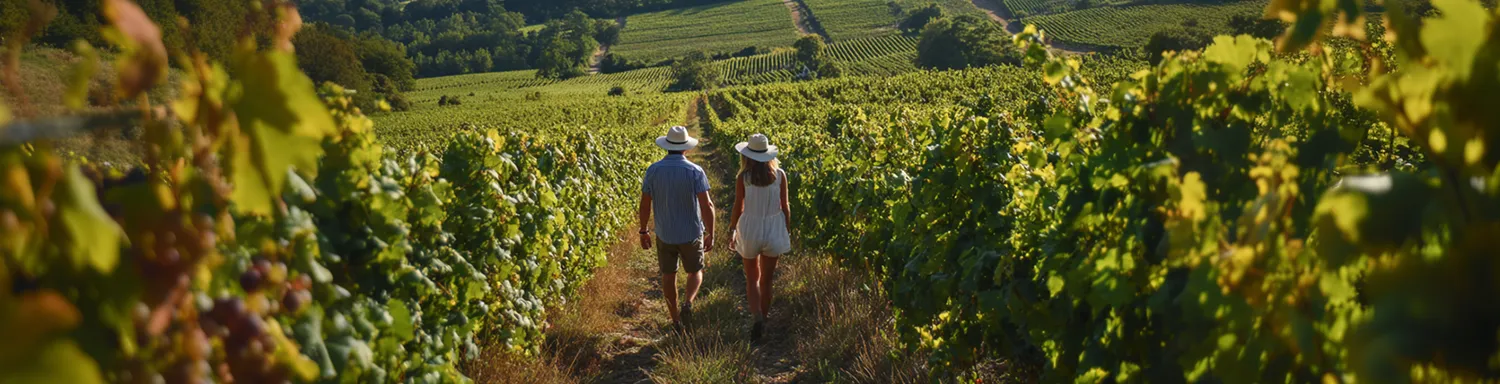
There is a particular quality of light in Burgundy in the late afternoon. It falls flat and golden across the vines, catches the limestone of a church tower, and makes everything feel as though it has always been exactly this way. In a sense, it has. The terroirs of the Côte d'Or have been mapped, tended and argued over for a thousand years — first by Cistercian monks who tasted the soil, then by négociants who bottled its complexity, now by vignerons who guard every parcel like a birthright.
Prefer a curated journey through domaines, medieval villages and vine-lined roads — with a guide who speaks both the language and the wine? Explore our Burgundy tours.

Jump to: The wine — a language worth learning • The villages • When to go • Getting there • Insider tips • FAQ
The wine — a language worth learning
Burgundy's greatness rests on two grapes: Pinot Noir for reds, Chardonnay for whites. What sounds simple becomes endlessly nuanced across the region's geography. The same variety, planted a few hundred meters apart on the same hillside, produces wines that taste nothing alike — and that, the Burgundians will tell you, is the whole point.
To travel through Burgundy is to move through living history — not displayed behind glass, but poured into a glass.
The classification — a few signposts for the uninitiated
Burgundy has four levels of appellation, from regional (Bourgogne) up through village, premier cru, and the revered grand cru — 33 plots that represent the pinnacle of the classification. Learning to read a Burgundy label is its own slow pleasure.
- Côte de Nuits: the great reds — Gevrey-Chambertin, Chambolle-Musigny, Vosne-Romanée.
- Côte de Beaune: white benchmarks — Meursault, Puligny-Montrachet, Corton-Charlemagne — alongside elegant reds from Pommard and Volnay.
- Côte Chalonnaise & Mâconnais: real quality at more accessible prices — Mercurey, Givry, Pouilly-Fuissé — and far fewer crowds.
Beaurouge tip: the best way into Burgundy's wine culture is through a domaine visit. Small, family-run estates welcome visitors by appointment; the experience is unhurried, personal, and nothing like a commercial tasting room.
Our guides open doors that don't appear on any list.
The villages — stone, silence and a market on Saturday
The wine is inseparable from the places that produce it. Burgundy's villages are among the most quietly beautiful in France — not dramatic, not postcard-obvious, but deeply satisfying to those who slow down.
Beaune — the natural hub
A medieval market town wrapped in ramparts, its Hospices de Beaune — a 15th-century hospital-charity with a polychrome tiled roof — one of the most photographed buildings in France. The Saturday market is the right way to begin a day; the old-town lanes, lined with wine merchants and quiet restaurants, are the right way to end one.
Gevrey-Chambertin — where the great reds begin
The village sits at the northern edge of the Côte de Nuits, surrounded by some of the most celebrated vineyard names in the world. Walk the Route des Grands Crus at dawn, before anyone else arrives — the silence between the rows is part of the experience.
Pommard & Meursault — two sides of the same slope
These villages face each other across a quiet stretch of the Côte de Beaune — the first producing structured, age-worthy reds; the second, Burgundy's most celebrated white. Both have an unhurried, lived-in quality that feels genuinely local, far from the tourist circuits of the larger towns.
Noyers-sur-Serein — a different register entirely
Further north in the Auxerre area, a medieval village encircled by the river, with half-timbered houses and a central square that has barely changed in five centuries. Fewer visitors, more atmosphere — the kind of place that earns a long lunch and a slow afternoon.
Vézelay — the Romanesque masterpiece
The basilica on the hilltop is one of the great buildings of medieval Europe — a pilgrimage church on the route to Santiago de Compostela, built in honey-colored stone, with a nave that seems to breathe light. It deserves a morning of its own, unhurried and without a schedule.
When to go
- Spring (April–June): bud break and flowering vines, gentle temperatures, thin crowds. The landscape is intensely green.
- Harvest (late September–mid-October): vines turn amber and red, the air carries the perfume of fermentation, and the vendanges bring a quiet energy to every village. Book early — rooms fill.
- Winter: underrated. Beaune's Saturday market continues; cellar visits are unhurried; the Route des Grands Crus under frost has a stillness that summer never offers.
Beaurouge tip: harvest season (late September) is the most atmospheric time to visit. The combination of vine color, new-wine perfume, and the low autumn light is unlike anything else in France.
We plan domaine visits during this period well in advance — estate calendars fill quickly once the harvest begins.
Getting there
Burgundy is well connected by TGV — Beaune and Dijon are both served from Paris in under two hours. From there, a private driver unlocks the smaller villages and domaine lanes that public transport doesn't reach.
- By train: TGV Paris–Dijon in 1h40; Paris–Beaune in under 2h.
- By car: the A6 autoroute follows the Côte d'Or; the Route des Grands Crus runs parallel, far more slowly and far more beautifully.
- Private driver: recommended for multi-domaine days — no logistics, no designated driver concerns, and full flexibility between villages.
Insider tips for a slow Burgundy rhythm
- Domaine visits: always by appointment; arrive with curiosity, not a checklist.
- Pacing: one valley or appellation per day, not a sprint between appellations.
- Lunch: the region's bistros and auberges reward lingering — plan an unhurried midday stop.
- Labels: ask your guide to walk you through reading a Burgundy label before the first tasting — the geography makes the glass make sense.
Beaurouge tip: a Burgundy day works best with a single through-line — one appellation, one village market, one long lunch. Trying to cover the entire Côte d'Or in a day produces logistics, not memories.
We build days with that kind of focus — and leave room for the unexpected detour down a vine lane.
Plan your Burgundy journey with Beaurouge
Burgundy rewards depth over speed. We build days around a single valley or appellation rather than rushing between highlights, and our guide-lecturers speak to the vignerons, the history and the glass in front of you with equal fluency. A typical day might move from a domaine visit in Gevrey-Chambertin in the morning to a slow lunch in Beaune, then an afternoon in the vineyards of Meursault as the light drops — ending with a bottle opened at the right moment, in the right place.
Burgundy — FAQ
Harvest season (late September to mid-October) is the most atmospheric — vine color, new-wine perfume, and exceptional light. Spring is beautiful for green landscapes and thin crowds; winter offers the most intimate cellar visits.
A private driver is strongly recommended for vineyard days — it unlocks domaine lanes, village detours, and wine tastings without logistics. TGV connections from Paris to Dijon and Beaune are excellent for getting there.
A minimum of three days to do it justice: one day along the Côte de Nuits (Gevrey-Chambertin, Vosne-Romanée), one along the Côte de Beaune (Beaune, Meursault, Pommard), and one for a quieter village or further exploration — Vézelay, Noyers, or the Mâconnais.
Entirely. The best approach is curiosity, not expertise. Our guides frame the geography, the vocabulary and the glass in a way that makes the region legible and enjoyable — no prior knowledge required.
Ready to plan? Browse our Burgundy tours or reach us via Contact.