
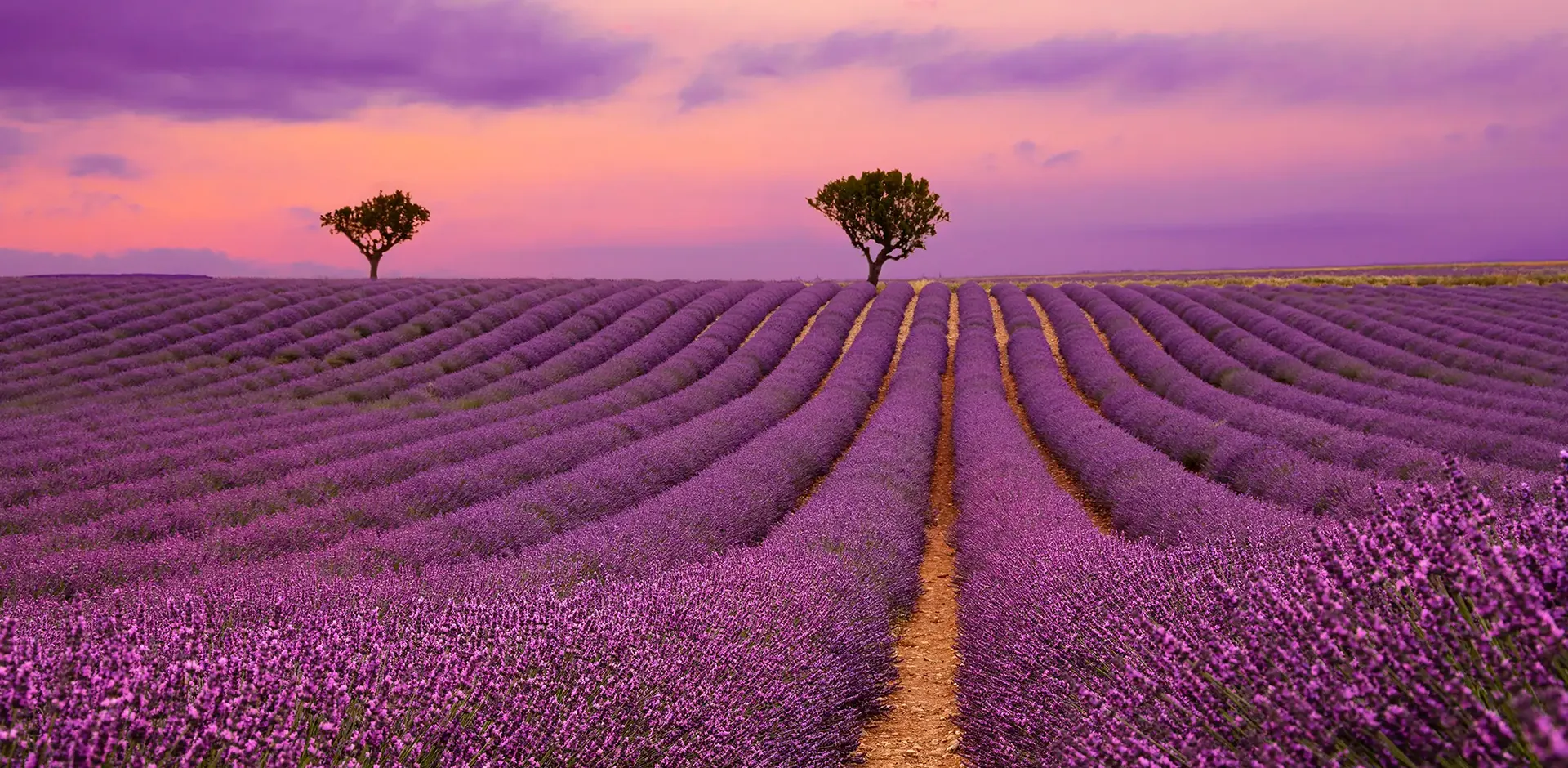
In short: most of the famous purple fields of Provence, including the Valensole plateau, are planted with lavandin (Lavandula × intermedia), not true lavender. Lavandin is a natural hybrid of true lavender and spike lavender. It produces several times more essential oil, but it is sterile, so every plant is a cutting. True lavender grows at higher altitude and remains the perfumers' choice.
Every summer, thousands of visitors photograph the endless violet rows of Provence. Very few realize that what they are looking at is, botanically speaking, not quite lavender. Here is the story behind the fields, from an ancient Greek physician to the perfumers of Grasse.
Lavender vs lavandin: what's the difference?
Provence grows two main plants that most people call "lavender":
| True lavender | Lavandin | |
|---|---|---|
| Latin name | Lavandula angustifolia | Lavandula × intermedia |
| Origin | Native wild plant of southern France | Natural hybrid of true lavender and spike lavender |
| Where it grows | Mountain slopes and higher ground (the protected Lavande de Haute-Provence must grow above 800 m / 2,600 ft) | Lower and mid-altitude plateaus, such as Valensole |
| Essential oil yield | 15–20 kg per hectare | 60–150 kg per hectare |
| Scent | Fine, sweet, delicate | Sharper, more camphor |
| Main use | Fine perfumery and cosmetics | Soaps, detergents, household products |
| Reproduction | Grows from seed | Sterile: propagated only by cuttings |
Lavandin dominates French production. In 2023, it covered about three quarters of France's lavender fields (22,260 hectares, against 8,394 for true lavender), and it produces the overwhelming majority of the essential oil: well over a thousand tonnes a year, against only 90 tonnes of true lavender oil in 2023. On the Valensole plateau, the most photographed of all, the fields are overwhelmingly lavandin.
Is lavender native to Provence?
Yes. A popular story says the Romans brought lavender to Provence. In fact, true lavender is a native plant whose natural range stretches from southern France to Italy: it was growing wild on the hills of Provence long before anyone cultivated it.
In antiquity, lavender was known mainly as a medicine. The Greek physician Dioscorides, whose 1st-century treatise was the reference for Roman medicine, describes a lavender called stoechas in remedies for chest complaints. There is little ancient evidence, however, for the popular image of Romans perfuming their baths with lavender.
There is a lovely local detail, too. Dioscorides wrote that stoechas took its name from the Stoechades islands, off the coast of Provence. They are today's Îles d'Hyères: Porquerolles, Port-Cros and the Île du Levant. The botanical name Lavandula stoechas still carries that memory.
How Grasse turned lavender into an industry
The turning point came in the 19th century. In the 1850s, the perfume industry of Grasse industrialized and began to use mountain lavender intensively. For decades, its perfumers relied on wild lavender, picked by hand by the villagers of Haute-Provence. By the late 19th century, small towns such as Barrême had several distilleries, sending their essence by rail to Grasse.
Planting only began to develop around 1925–1930. Then came lavandin: from the 1930s, farmers started cultivating it intensively, and from the 1950s it became a truly industrial crop. Harvesting on the Valensole plateau was mechanized in the 1970s. Lavandin's appeal was simple: it grows at lower altitude, on flatter land, and yields several times more oil.
True lavender did not disappear. In 1981, its essential oil received its own protected designation of origin, Huile essentielle de lavande de Haute-Provence, which helped revive its cultivation. Fittingly, the rules require plants grown from seed only: no clones allowed.
Do Grasse perfumers use lavender or lavandin?
For fine fragrance, perfumers still prefer true lavender: its scent is more delicate and its essence more consistent. Lavandin, richer in camphor, is mostly used in functional perfumery, the scents of soaps, detergents and household products. So the field you photographed in Valensole may well end up in your laundry.
If you want to experience this side of the story, our Riviera Hilltop Villages & Perfume day includes Grasse, the Fragonard Perfume Museum and an optional workshop where you create your own fragrance.
Why do lavandin fields look so perfectly uniform?
Lavandin cannot reproduce through viable seeds, so farmers propagate it through cuttings. Every plant is a genetic copy of another: same height, same shade of violet, same flowering time. Planted in carefully spaced rows for easier cultivation and mechanical harvesting, these identical plants form the spectacular purple patterns that have become a symbol of Provence. Those perfect rows that look so good on Instagram? Millions of clones.
More than a photo backdrop
The violet fields are only the visible part of the story. Behind them are generations of growers who first climbed the mountains to pick wild lavender, the small distilleries that still fill the air with steam in July, and the perfumers of Grasse who turned a mountain plant into an industry. This is why we like to visit the fields with a local guide: once you know what you are looking at, a lavender field becomes a landscape you can read, from the altitude of the plot to the shape of a flower spike.
How to tell lavender from lavandin in the field
- Look at the flower spikes. True lavender has short, compact, rounded spikes. Lavandin has long, slender, pointed spikes.
- Look at the stems. True lavender carries one spike per stem. Lavandin stems often branch, with small side spikes.
- Look at the plant. Lavandin forms large, round bushes with many long stems. True lavender stays smaller and lower.
- Look at the landscape. Vast flat fields at moderate altitude, like Valensole, almost always mean lavandin. Smaller plots on mountain slopes in Haute-Provence are more likely true lavender.
- Smell it. Lavandin has a sharper, slightly medicinal camphor note.
When to see the lavender fields in bloom
Lavender and lavandin bloom from mid-June to mid-August, depending on altitude and the year's weather. Lower fields flower first; mountain lavender blooms later. Harvest can begin as soon as the flowers peak, so it is wise to plan your visit with a local who follows the season.
Experience the lavender of Provence with Beaurouge
Our private Provence Curated Journeys can include a visit to a lavender distillery and, in season, a walk through the fields, alongside perched villages, markets and vineyards. For a day among the hilltop villages of the Luberon, see Provence & Luberon Perched Villages. You will find all our ideas for the region on our Provence page.
FAQ
Are the lavender fields of Valensole real lavender?
Mostly not. The large fields of the Valensole plateau are overwhelmingly planted with lavandin, a hybrid of true lavender and spike lavender. True lavender is grown at higher altitude.
Is lavandin a natural plant or man-made?
Lavandin is a natural hybrid that occurs where true lavender and spike lavender grow together. Farmers then selected and propagated it by cuttings, because it is sterile.
Who brought lavender to Provence?
No one. True lavender is native to southern France and was already growing wild in Provence. In antiquity, it was known mainly as a medicine.
Which lavender is used in perfume?
Fine perfumery mostly uses true lavender, prized for its delicate scent. Lavandin, richer in camphor, is mainly used in soaps, detergents and household products.
When is the best time to see lavender in Provence?
From mid-June to mid-August, depending on altitude and weather. Lower lavandin fields bloom earlier than mountain lavender.
Planning a trip to Provence? We design private, tailor-made journeys with local guides who know the stories behind every field. Let's plan your trip.
Sources
- FranceAgriMer, Focus Lavande Lavandin 2023 (surfaces and production figures)
- INAO, specification of the AOP Huile essentielle de lavande de Haute-Provence (altitude, history, 1981 decree)
- French Ministry of Culture, Les pratiques de culture des lavandes en Haute-Provence (Grasse, Barrême, lavandin, mechanization)
- Routes de la Lavande, Lavande ou lavandin ? (oil yields, uses)
- Royal Botanic Gardens, Kew, Plants of the World Online (native range of true lavender)
- From antiquity to modern hygiene: the archaeological and medicinal legacy of lavender (2025) (ancient uses, Dioscorides)
- nunc.ch, In antiquity, lavender didn't cleanse, it cured (ancient medical uses, the Stoechades islands)